Agriculture in Burundi
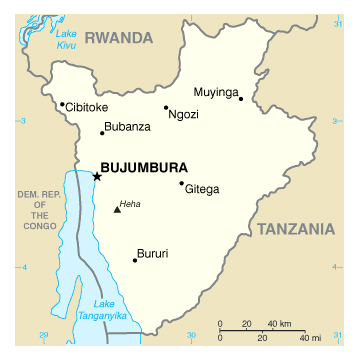 According to the Global Hunger Index, Burundi scores the second highest level of hunger in the world after the DRC and has one of the highest chronic malnutrition rates in the world. More than 60% of the population of 8.4 million people is undernourished. Over 90% of the active population is working in the agricultural sector, which contributes around 50% to GDP of 1.5 billion US$ (180 US$ per capita) . Its overall growth (estimated at 2.6%) remains below that of population growth (3 %). Approximately 1.2 million rural households have an average plot of 0.5 ha to practice subsistence agriculture.
Due to the favorable climate, the potential for improving agricultural productivity is very high: actual production levels could easily be multiplied by three to five, allowing for market-oriented production instead of the now dominant subsistence agriculture. Without sufficient use of inputs, subsistence agriculture will lead to more and more land degradation and, in combination with population growth, more and more people will have to live from increasingly smaller plots.
Burundi has good policy documents for the development of the agricultural sector, of which the most recent is the Plan National d’Investissement Agricole 2012 – 2017 (PNIA), which is based on the Stratégie Agricole Nationale (SAN) 2008 - 2015. The plan identifies more than 15 agricultural value chains to be promoted and reinforced: coffee, tea, cotton, quinquina (export crops), milk, meat, palm oil, banana, potato, paddy, wheat, cassava, beans, fruits, flowers, etc. (for local consumption AND export with added value through processing). The plan also reserves a large part of the investments to development of irrigation: 22%. It affirms the need of reform and capacity building of the ministry of agriculture, in order to enable it to put the new policies into practice.
Agri-ProFocus Burundi
The kick-off of Agri-ProFocus Burundi Agri-Hub took place on 28-29 June 2012. About sixty representatives of organisations, companies and services operating in agricultural value chain development responded to the challenge of searching for a new way of cooperation to make their work more effective.
The Burundi Agri-Hub promotes farmer entrepreneurship by increasing access of smallholder farmers to finance, inputs, markets and value chains. Halfway through 2013, the Agri-Hub comprises more than 150 professionals. In 6 innovation communities, these people work together to push for:
- Improvement of farm-firm relations within value chains
- Access to credit and agricultural insurance for farmers
- Access to quality inputs and land
- Gender balance in agricultural development
All groups organise network events, including a finance fair in November 2013.
Agri-Hub Burundi, together with Agri-Hub Rwanda and Agri-Hub RD-Congo, is developing a ‘Grands Lacs’ programme of activities. These regional activities concern action-research programmes on specific value chains (potatoes, manioc) and some regional exchange events.

 Nous avons migré vers notre nouvelle plate-forme en ligne!